RESEARCH 004 · AUTISM & ADHD · CHILD HEALTH · UNITED STATES
Different needs. Care that responds.
Autism, ADHD and healthcare access: an exploratory US child survey analysis of unmet need, emergency use, hospital admission and treatment.
Explore the findings ↓01 / OVERVIEW
Different needs deserve responsive care.
Children with parent-reported current autism or ADHD diagnoses show higher levels of unmet healthcare need, emergency use and overnight hospital admission than children with neither condition identified.
We analyse public individual-level survey data to investigate where care pathways could respond better to different needs. This report expands our work beyond cardiovascular health.
02 / KEY FINDINGS
Access should respond to need.
1. Needed care is more often left unmet
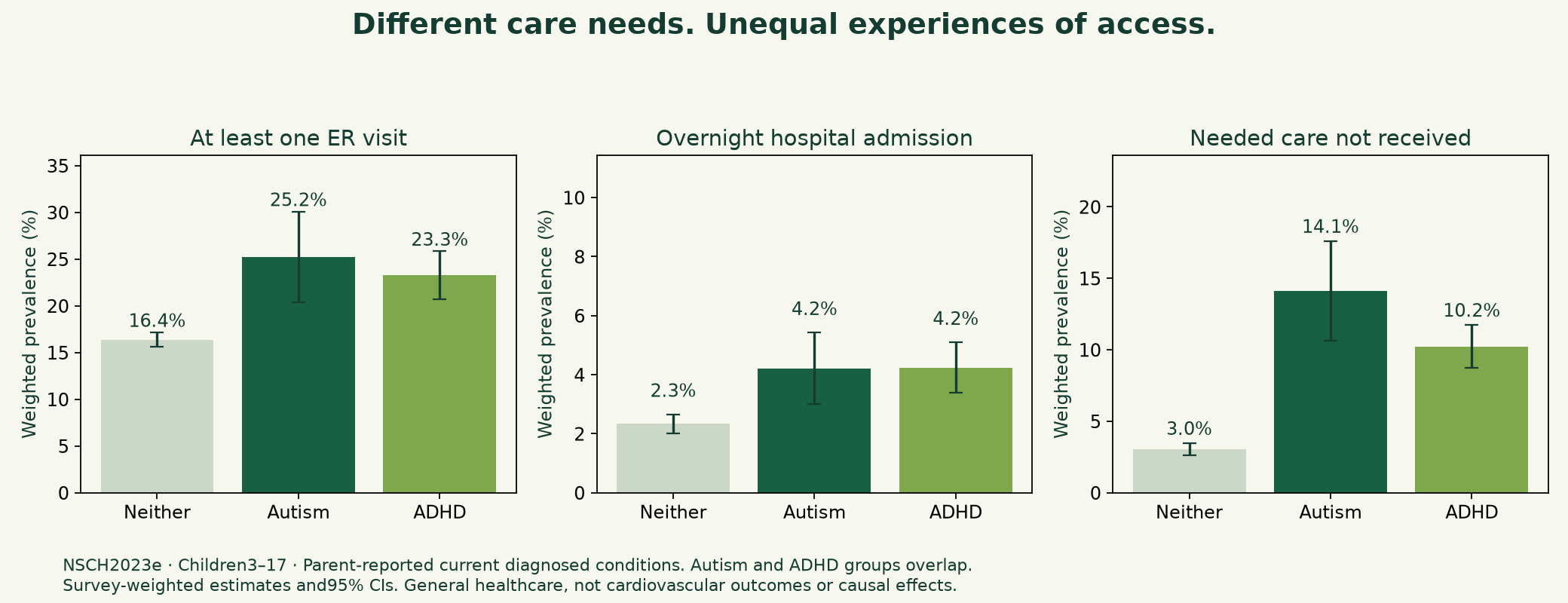
In weighted estimates for children aged 3–17, needed healthcare was not received during the previous 12 months for 14.1% of children with autism (95% CI 10.6–17.6%) and 10.2% with ADHD (8.7–11.7%), compared with 3.0% (2.6–3.4%) among children with neither condition identified.
After adjustment for age, sex, current insurance and state, the odds ratios are 5.57 for autism (4.03–7.68) and 3.77 for ADHD (3.03–4.70). These are odds ratios, not risk ratios or causal effects.
2. Greater use of emergency and hospital care
At least one emergency-room visit was reported for 25.2% of children with autism and 23.3% with ADHD, versus 16.4% in the comparison group. Overnight hospital admission was reported for 4.2% in each condition group versus 2.3%.
Adjusted emergency-visit ORs are 1.66 for autism (1.27–2.17) and 1.66 for ADHD (1.42–1.96); admission ORs are 1.87 (1.35–2.60) and 2.03 (1.58–2.60). All six adjusted comparisons remain significant after BH correction. Greater utilisation can reflect greater need and comorbidity; it does not establish inappropriate care or that unmet care caused an admission.
3. Treatment use: describe before judging
Current medication use was reported for 53.0% of children with ADHD (50.3–55.7%). The autism-specific medication question yielded 20.1% (16.7–23.4%). Behavioural treatment was reported for 48.4% with ADHD and 62.0% with autism.
These measures do not establish dose, adherence, effectiveness or whether medication is appropriate for an individual. Medication reported for autism should not be interpreted as treatment of its core characteristics. No medication does not automatically mean undertreatment.
Where could care respond better?
Investigate coordination, understandable communication, appointment flexibility, sensory accessibility and family support with children, families and clinicians. These are candidate improvements to evaluate, not interventions proven by this analysis.
03 / METHODOLOGY
An individual-level survey analysis.
Source: public NSCH 2023e topical file, enhanced-weight version. The full sample contains 55,162 children; 45,693 are aged 3–17. Current autism is identified in 1,933 and ADHD in 5,235, with 861 in both groups. Diagnoses are reported by families as having been made by a healthcare professional.
Current status is yes when the current-condition item is yes; explicit never-diagnosed or current-no responses define no. Unknown responses remain missing. The comparator has neither autism nor ADHD identified; it is not defined as neurotypical. Item-specific valid samples differ.
Population estimates use selected-child weights FWC. State×STRATUM defines 102 sampling strata, with HHID as the household unit. Taylor score linearisation retains the full survey design, assigning zero influence outside the analysis domain. There are no singleton strata. No finite-population correction is applied.
Weighted logistic models adjust for age, sex, current insurance and state. BH correction covers six primary comparisons. Confidence intervals for descriptive prevalence are not simultaneous. Medication estimates were independently reconciled by weighted grouped sums. Variable coding, checks and methods are downloadable.
04 / LIMITATIONS
What these results do not establish.
This is a cross-sectional, parent-reported survey of children in households. Diagnosis, healthcare use and access may be affected by reporting and ascertainment differences. Autism and ADHD groups overlap and are not independent replications.
Models do not fully account for condition severity, comorbidity, income or all care needs. An adjusted association is not proof that a diagnosis itself causes an access barrier. General emergency visits and admissions are not cardiovascular outcomes.
Results do not represent adults, all neurodivergent people or county-level patterns. The medication questions do not measure adherence, dose or treatment quality. The variance implementation has internal checks; an independent external survey-software replication remains desirable.
05 / CONCLUSION
Build care around different needs.
Unmet healthcare need is more commonly reported among children with current autism or ADHD diagnoses, alongside higher emergency and hospital use. The pattern remains after the measured demographic and insurance adjustment.
The opportunity is to investigate how access and continuity can better match individual needs, with families and neurodivergent people involved in designing and evaluating care pathways.
06 / SOURCES
Public data. Reusable methods.
- Census: NSCH 2023e public-use data.
- NSCH 2023 methodology report.
- NSCH variable codebook: diagnosis, healthcare experience and treatment questions.
07 / CITE & DOWNLOAD
Explore and question the findings.
The Smart Mole Institute. Different needs. Care that responds. Research 004. Version 1.0. 13 October 2026. Exploratory survey analysis of NSCH 2023e children 3–17; not peer reviewed.
08 / CONTINUE THE CONVERSATION
What should we
investigate next?
Share a question, suggest a correction, or explore collaboration on accessible care and continuity.
Contact the Institute ↗