RESEARCH 002 · RURAL HEART HEALTH · UNITED STATES
Rural heart health.
Bringing care closer.
Higher rurality is associated with lower medical service use. Explore US county evidence and 394 counties with stronger digital conditions for remote care.
Explore the findings ↓01 / OVERVIEW
Care should not depend on your postcode.
Across US counties, greater rurality is strongly associated with lower use of medical evaluation and management services. The question is how to bring care closer to the people who need it.
We connect healthcare utilisation, rurality, education and household digital resources to investigate where remote assessment, prevention and follow-up could be explored as part of cardiovascular care. This is an analysis of territorial patterns, using general medical service use alongside heart-related outcomes.
02 / KEY FINDINGS
A care gap. An opportunity to connect.
1. Greater rurality, less medical evaluation and management
Across 3,140 counties with available data, rurality and evaluation and management (E&M) utilisation show a strong inverse association: Spearman ρ = −0.604. The median county rate is 13,280.6 events per 1,000 Original Medicare beneficiaries in metropolitan counties, compared with 9,760.8 in nonmetropolitan counties: a 26.5% lower median rate.
E&M captures general medical evaluation and management across settings. It does not exclusively measure cardiology consultations, unique patients or unmet need.
2. The gap persists among counties with more comparable profiles
After propensity-score overlap weighting on observed demographic, socioeconomic and Medicare characteristics, the nonmetropolitan E&M rate remains 7.2% lower: a ratio of weighted county mean rates of 0.928 (95% interval 0.904–0.949), equivalent to approximately 868 fewer events per 1,000 beneficiaries.
Education and financial circumstances do not fully account for the observed utilisation pattern. These weighted results describe counties in the population of covariate overlap; the 26.5% median comparison and 7.2% weighted comparison are different summaries.
3. A heart-related emergency signal deserves attention
In the separately eligible, overlap-weighted outcome analysis, emergency-department use for heart failure and non-ischaemic heart disease combined is 6.5% higher in nonmetropolitan counties: rate ratio 1.065 (95% interval 1.005–1.125).
This secondary signal sits alongside lower general E&M use. It does not show that emergency visits replace routine care. Its interval is close to the null, and it remains exploratory.
Where could digital care bring services closer?
Among nonmetropolitan counties with E&M use below the nonmetropolitan median, 394 counties meet both of our stronger digital conditions: fixed internet subscription and older residents’ access to a computer or device with broadband at or above the respective nonmetropolitan medians. They offer a starting shortlist for exploring remote care pathways.
A further 584 counties have similarly lower service use but fall below at least one digital threshold. Here, remote care initiatives should consider connectivity, devices and practical support together. These are relative screening categories, rather than measured telehealth uptake or a validated opportunity index.
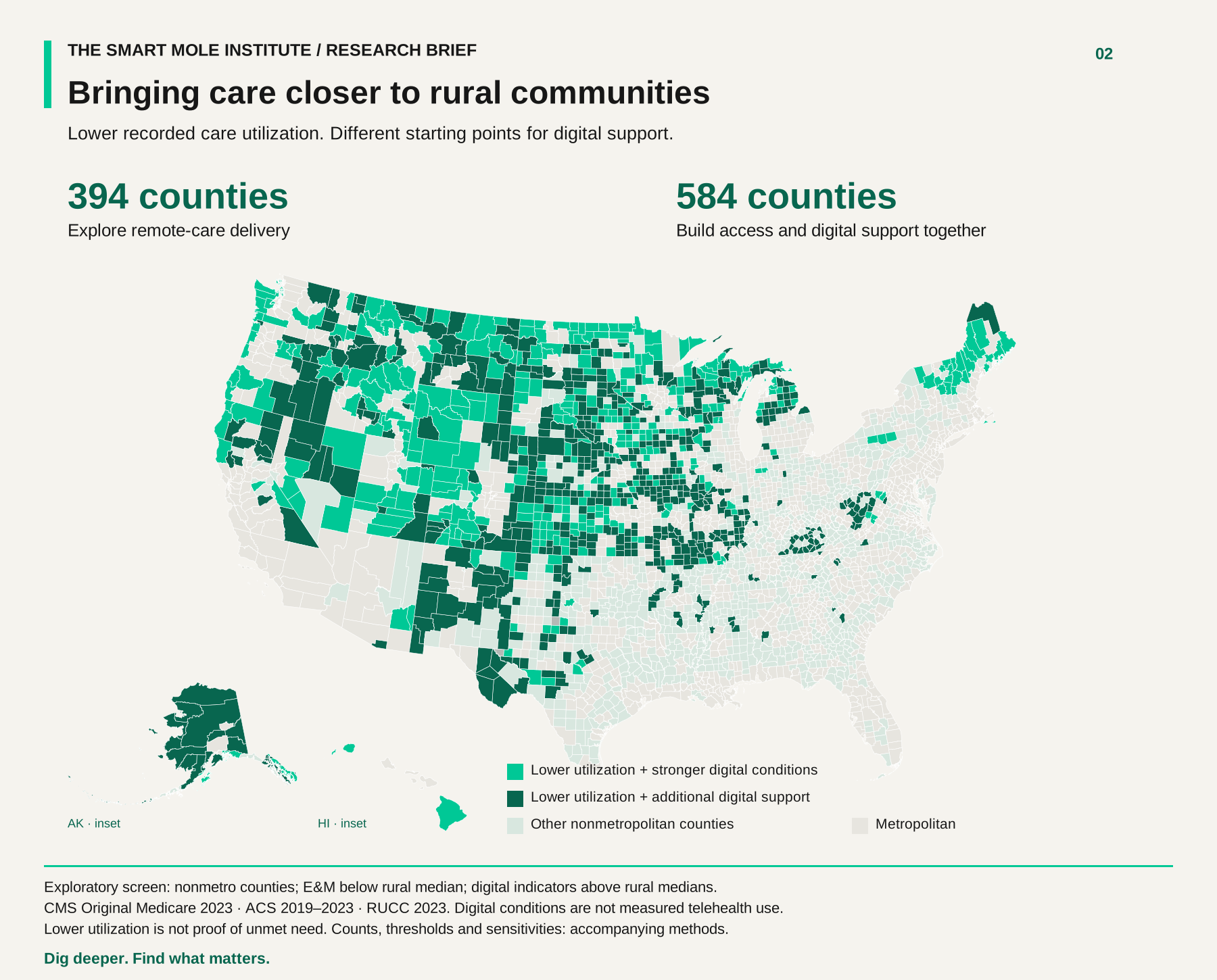
From observation to action
Use the map to ask a practical health question: where could remote assessment, preventive support and continuity of care complement existing services? Local service capacity, patient preferences and actual telehealth use should shape the next investigation.
03 / METHODOLOGY
How we investigated
This exploratory ecological analysis links a 3,144-county framework covering 50 states and DC to 2023 CMS Original Medicare utilisation and Mapping Medicare Disparities outcomes, USDA 2023 Rural–Urban Continuum Codes (RUCC), and ACS 2019–2023 five-year socioeconomic, education and digital estimates. Available observations differ by analysis.
Rurality and denominators
RUCC 1–9 is treated as an ordered rurality measure for rank correlation. It is not a uniformly spaced distance scale. RUCC 4–9 defines the nonmetropolitan group; not every resident of these counties lives in a rural settlement. E&M rates count events per 1,000 Original Medicare beneficiaries. The reported median contrast is a comparison of county medians, not a pooled population rate.
Comparable observed profiles
A logistic propensity model includes log population, log household income, bachelor’s attainment, less-than-high-school attainment, female population share, Medicare beneficiary mean age, Medicare Advantage share and state effects. Rural counties receive weights 1−p and metropolitan counties weights p. Initial one-to-one matching did not achieve sufficient balance; overlap weighting is the main comparison. Recorded outcome-specific balance diagnostics accompany the downloads.
Ratios compare weighted county mean rates. Intervals use 3,000 state-block bootstrap replicates with propensity scores held fixed. They do not include uncertainty from refitting the propensity model, ACS estimates or simultaneous testing. Additional education, state and spatial sensitivity models support the utilisation pattern; they are sensitivity analyses of the same data, not independent replications.
Clinical outcomes and standardisation
The emergency outcome combines heart failure and non-ischaemic heart disease in CMS Mapping Medicare Disparities. It is an age-adjusted rate per 1,000 beneficiaries, using its separately eligible county sample. E&M is a general utilisation rate and is not age-standardised in the same way. Adjustment for demographic composition in the weighting model is recorded explicitly; no second direct age-standardisation of published age-adjusted outcomes is applied.
Digital screening
Of 1,954 nonmetropolitan counties with the three required measures, 978 have E&M use below 9,760.76435 events per 1,000. Stronger digital conditions require fixed cable/fibre/DSL subscription of at least 60.08475% of households and computer/device plus broadband access of at least 74.10750% among household residents aged 65+. This older-resident measure can include smartphones and mobile or satellite broadband; it does not measure digital skills. The 394/584 split is an illustrative operational screen selected without mortality optimisation. Missing data are not treated as zero.
The map uses Census county boundaries with separate Alaska and Hawaii insets. Its dataset and exact thresholds are downloadable below.
04 / LIMITATIONS
What these observations can tell us
The findings describe county-level associations and generate hypotheses. They do not establish individual exposure, causal effects or the number of preventable events. Lower service use can reflect access barriers, different needs, service organisation or care received elsewhere. Medicare results should not be generalised directly to all US residents.
Overlap weighting balances measured characteristics within the overlap population; unmeasured differences and spatial dependence remain. Formal educational attainment is not a direct measure of health literacy. Exploratory intervals are not adjusted for multiple comparisons, and the emergency signal requires further validation.
Age-adjusted mortality comparisons do not show a clear rural excess after overlap weighting: women’s rate ratio is 1.019 (95% interval 0.997–1.039), and men’s is 1.012 (0.992–1.031). Therefore, this publication does not claim that lower E&M use causes higher mortality.
Digital subscriptions do not establish affordability, connection quality, skills, willingness to use remote care or actual telemedicine utilisation. CMS telehealth trends provide state and rural/urban summaries, not a county-level measure integrated here. The map identifies places to investigate, not proven benefits from an intervention.
05 / CONCLUSION
Bring care closer. Match the pathway to the place.
Greater rurality is strongly associated with lower medical evaluation and management use (ρ = −0.604), and a utilisation gap remains after balancing observed county characteristics. A secondary signal of higher heart-related emergency use strengthens the case for investigating how routine assessment, prevention and follow-up reach rural communities.
The digital map turns these observations into a practical agenda: explore remote-care pathways in 394 lower-use nonmetropolitan counties with stronger digital conditions, and pair that approach with additional digital support in a further 584. These are places to investigate and work with, rather than estimates of proven intervention benefit. The priority is to connect people with appropriate care and evaluate what improves access and health.
06 / SOURCES
Open sources. Connected questions.
- CMS Medicare Geographic Variation: 2023 county E&M rates and beneficiary context.
- CMS Mapping Medicare Disparities: 2023 heart-related emergency use and mortality; technical documentation.
- USDA Rural–Urban Continuum Codes: 2023 classification and definitions.
- US Census American Community Survey: 2019–2023 five-year estimates, including B15003 education, B28002 internet subscription and B28005 age, device and internet access.
- US Census cartographic boundaries: county mapping.
- CMS Medicare Telehealth Trends: context for future work; county uptake is not inferred from state summaries.
07 / CITE & DOWNLOAD
Explore, reuse and question.
- Standalone article (HTML)
- Overlap-weighted results (JSON)
- Balance diagnostics (JSON)
- County map data (JSON)
- Map definitions and thresholds (JSON)
- Citation (TXT)
The Smart Mole Institute. Rural heart health. Bringing care closer. Open research brief 002. Version 1.0. 12 October 2026. Ecological exploratory analysis; not peer reviewed. Sources: CMS 2023; ACS 2019–2023; USDA RUCC 2023.
08 / CONTINUE THE CONVERSATION
What should we
investigate next?
Share a question, suggest a correction, or explore collaboration on rural cardiovascular care.
Contact the Institute ↗